
7 Things You’ll Learn in a Pottery Workshop in Fes
Pottery Looks Simple Until You Touch the Clay
Watching an experienced potter in Fes can make the craft look almost effortless. A lump of clay is placed on a spinning wheel; a few controlled movements follow; and suddenly a bowl, cup or vase begins to appear. But the moment you sit at the wheel yourself, you discover what the finished ceramics in Fes do not immediately reveal: pottery depends on touch, timing, balance and patience.
That is what makes a pottery workshop in Fes more than another activity to add to a Morocco itinerary. It gives you a practical introduction to a craft that you will keep noticing afterward, in atelier shelves, medina shops, riads, restaurants and family homes. Instead of only seeing a finished plate or tagine, you begin to understand the sequence of decisions and skilled movements behind it.
The exact experience depends on the workshop you book. A pottery-making session may focus on preparing and shaping clay, including time at the potter’s wheel. A pottery-painting session usually begins with a prepared ceramic piece and focuses on pattern, line and colour. Drying, glazing and firing also take time, so some stages may be demonstrated or explained rather than completed during a short visitor session.
With that distinction in mind, here are seven of the most useful things a beginner can learn from a genuine pottery workshop in Fes.
1. You Learn How Clay Behaves in Your Hands
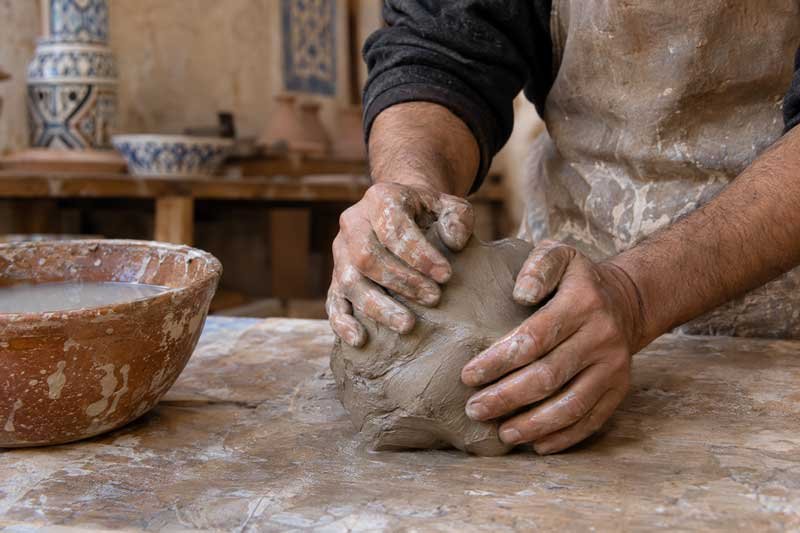
Your first lesson often begins before the wheel starts turning. Clay changes constantly according to pressure, moisture and movement. Press too hard and a form can collapse. Add too much water and the surface may become difficult to control. Work too cautiously and the clay may barely move at all.
For a beginner, this is one of the most memorable discoveries. Pottery is tactile. You learn through your fingertips rather than through a long explanation. An artisan may show you how to press, support, smooth or compress the clay, then let you repeat the motion until you can feel the difference.
This simple contact with the material also changes the way you look at handmade ceramics. Small variations in a bowl or vase no longer feel like imperfections; they can become visible traces of the making process. You start to notice the human decisions hidden inside an object that previously looked completely finished.
2. You Learn the First Movements of the Pottery Wheel
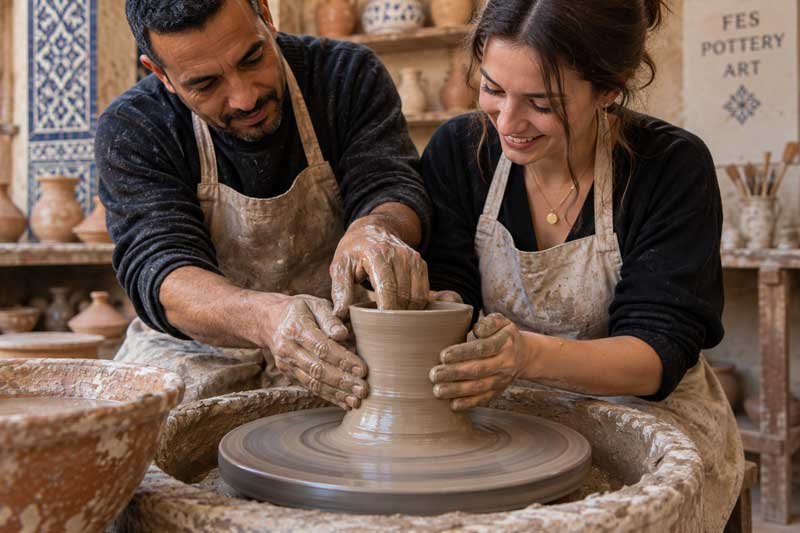
The potter’s wheel is usually the part beginners are most excited to try, and the part that most quickly reveals the artisan’s skill. Before you can create an elegant form, the clay needs to be controlled on the centre of the wheel. When it is off-centre, even slightly, the movement becomes uneven.
Under guidance, you may learn how to steady your hands, use the rotation of the wheel rather than fight it, and begin opening the clay from the centre. The goal of a first attempt is not perfection. It is to understand the relationship between speed, hand position and pressure.
This is also where watching a master potter becomes especially valuable. A movement that looks small can have a large effect on the clay. The artisan knows when to support the outside wall, when to apply pressure from within and when to stop touching the piece. A beginner starts by learning those principles, even if the finished form remains simple.
3. You Learn How a Simple Pottery Form Takes Shape
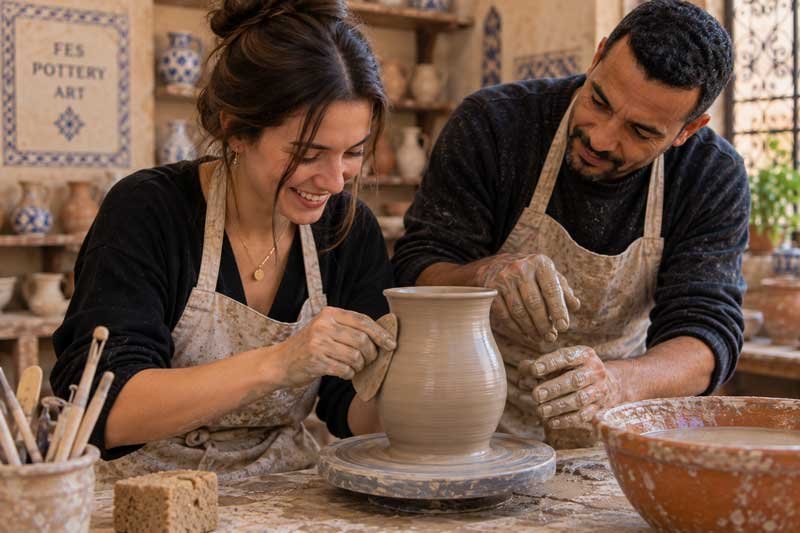
Once the clay is centred and opened, you can begin to understand how a three-dimensional object is built. A basic cylinder can become a cup, a small bowl or the beginning of a vase depending on how the walls are raised and shaped.
The important lesson is that a pot is not simply “pulled out” of clay in one movement. Its proportions develop gradually. The base needs enough thickness. The walls need support. The rim needs attention. If one area becomes too thin, the piece may lose stability.
A beginner-friendly pottery class in Fes should make this process understandable rather than rushing you toward a perfect souvenir. Even producing a modest shape teaches you how much coordination is required. And when the artisan corrects a wobbling wall with one precise movement, you see the difference between first-day practice and years of repetition.
Ready to Try Pottery With Your Own Hands?
Choose the pottery experience that matches what you want to learn.
Explore pottery-making and pottery-painting workshops in Fes, meet local artisans, and experience Moroccan ceramics from the inside rather than only from a shop shelf.
4. You Learn Why Refining a Piece Matters
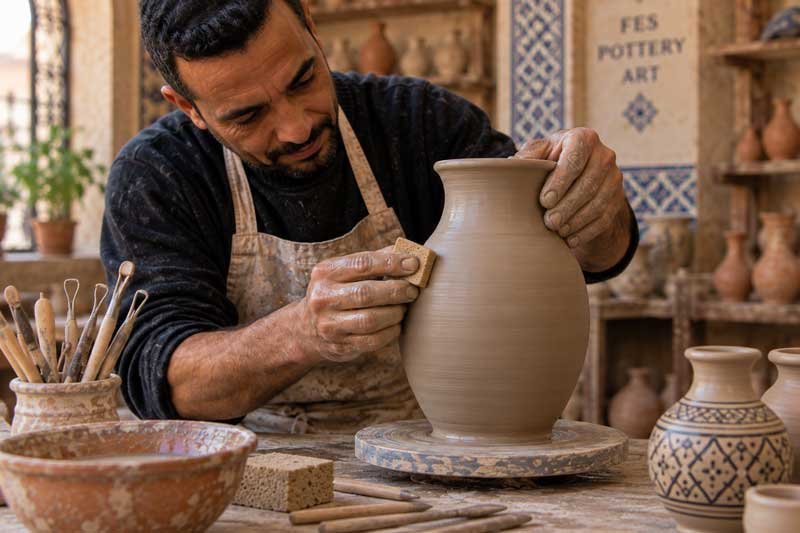
Shaping is only part of pottery. Artisans also refine the object: smoothing surfaces, correcting edges, defining the rim and checking the overall balance of the form. These finishing movements can be less dramatic than throwing clay on the wheel, but they have a major influence on the final quality.
During a workshop, you may learn to use your fingers or a simple tool to smooth a surface and remove excess material. You may also notice that the artisan repeatedly looks at the profile of the piece rather than only at the area being touched.
That habit teaches an important design lesson: pottery is judged as a whole. The curve of a bowl, the relationship between its base and opening, and the neatness of its rim all affect how the object feels. Refinement is where an approximate shape begins to look intentional.
5. You Learn How Moroccan Ceramic Decoration Is Built
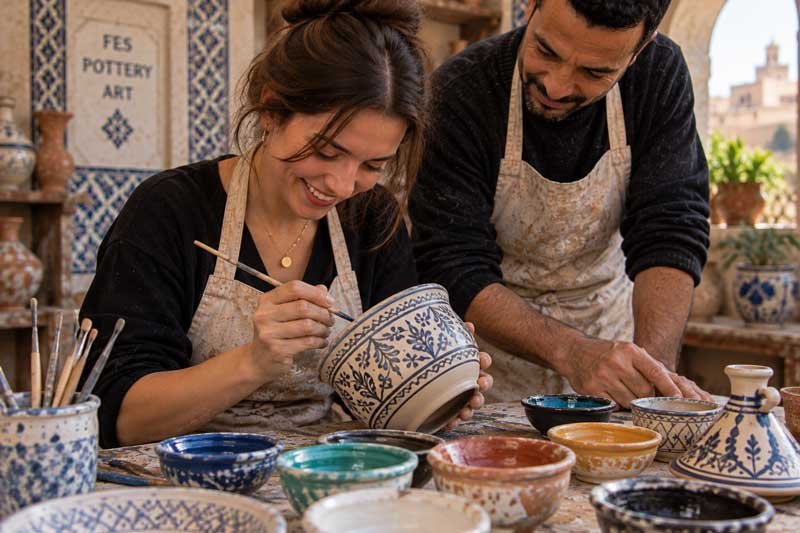
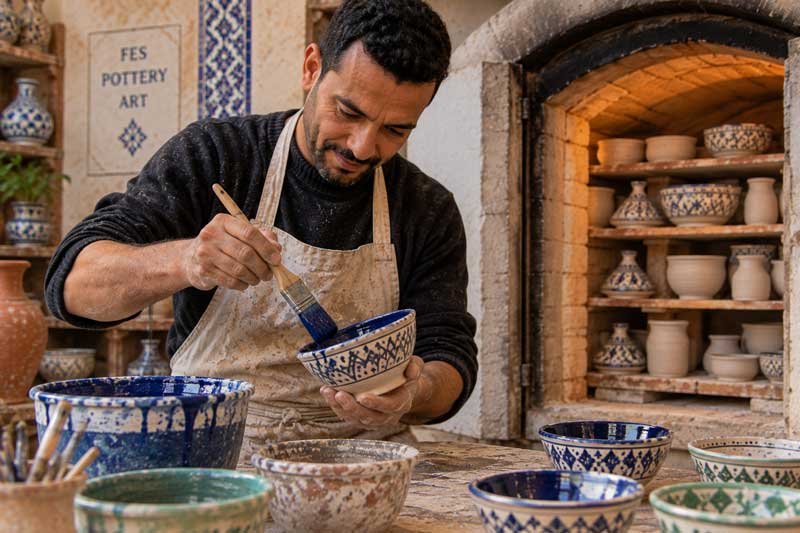
Fes is strongly associated with decorated ceramics, including the blue-and-white visual language often linked with traditional Fassi pottery. In a painting-focused session, or when decoration is included in your workshop, you can explore how a plain ceramic surface becomes a composed design.
The process is not simply filling empty space with colour. Moroccan-inspired decoration often depends on rhythm, repetition, borders, floral forms and geometric structure. On a curved bowl or plate, the painter must also adapt the design to a surface that is not flat.
A beginner may start with a simple motif, a border or a small repeated element. This is enough to discover how difficult consistent brushwork can be. It also encourages you to look more closely at the ceramics you encounter later in Fes: the spacing between motifs, the symmetry of a composition and the confidence of each painted line.
Important: pottery painting and pottery making are related but different experiences. If painting is your main interest, choose a session that specifically includes ceramic decoration rather than assuming every wheel-based pottery workshop includes it.
6. You Learn Why Drying, Glazing and Firing Cannot Be Rushed
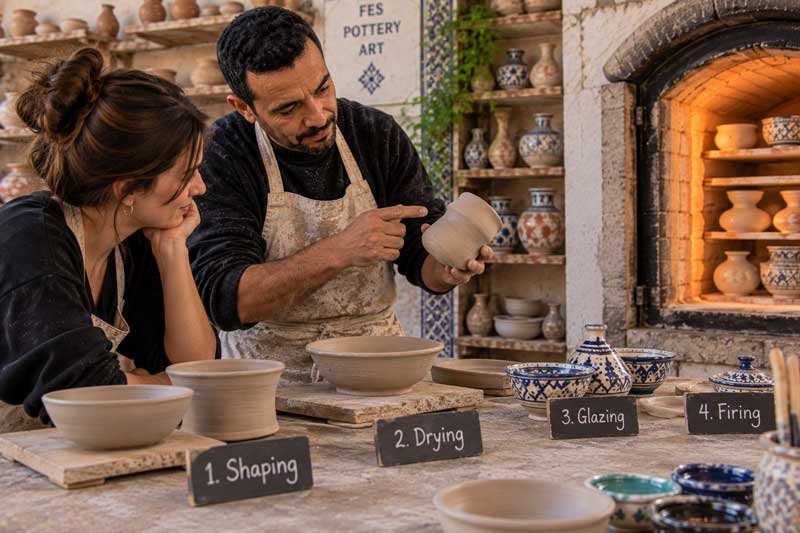
A visitor can shape a piece in minutes, but that does not mean the pottery is finished. Fresh clay contains moisture and needs time to dry gradually. If the process happens unevenly, the piece can crack or deform.
After drying, pottery may go through firing and surface-finishing stages depending on the technique. Glaze can change both appearance and function, while kiln firing transforms the fragile dried clay into ceramic material. Some pottery processes involve more than one firing.
This is one reason a responsible workshop should clearly explain what you will practise yourself and what you will observe or learn about. A short traveler workshop cannot compress every drying and firing stage into two hours. If you create a fresh clay object, ask whether it will be fired later, when it can be collected, and whether shipping is available if you leave Fes before it is ready.
Learning this timeline is valuable because it reveals the hidden waiting inside handmade craft. Pottery is not only hand skill; it is also a process of respecting material and time.
7. You Learn to See Fes Ceramics Differently
Perhaps the most lasting lesson happens after the workshop. Once you have tried to centre clay, raise a wall, smooth a rim or paint a repeated motif, handmade pottery becomes easier to appreciate.
You begin to notice whether a form is balanced. You understand why a hand-painted pattern requires concentration. You can imagine the stages that happened before a finished bowl reached a shop shelf. And you become more curious about the differences between a handmade piece, a decorated prepared object and a mass-produced souvenir.
That change in attention is one of the best reasons to learn pottery while travelling. You do not need to become a potter. The workshop gives you enough practical experience to become a more informed observer of the craft, and to connect the ceramics you see around Fes with the people, materials and processes behind them.
What Should a Beginner Expect?
You do not need previous pottery experience to benefit from a beginner session. A good workshop breaks the process into manageable steps and gives you direct guidance when the clay begins to move in an unexpected way, which it probably will.
Wear comfortable clothes that can tolerate a little clay or pigment. Keep your nails practical if possible, and arrive ready to use both hands. If you are travelling with children, ask about age suitability and how much hands-on wheel time is included.
Most importantly, do not judge the experience only by whether your first bowl looks perfect. The real value is understanding the process, meeting the person teaching it and leaving with a more informed appreciation of Moroccan pottery.
Questions to Ask Before Booking a Pottery Workshop in Fes
- Will I shape fresh clay, paint a prepared ceramic piece, or do both?
- Will I personally use a pottery wheel?
- How much of the session is hands-on?
- What is the workshop duration?
- Is the experience suitable for complete beginners or children?
- If I make fresh pottery, when will it be fired and ready?
- Can I collect the finished piece later or arrange shipping?
- Which languages are available for instruction?
FAQ: Learning Pottery in Fes
Do I need pottery experience before joining a workshop in Fes?
No. Beginner pottery workshops are designed to introduce the basic movements step by step. The exact level of participation varies, so check the workshop description before booking.
Can I learn to use a pottery wheel in Fes?
Yes, some pottery-making workshops include guided wheel work. Confirm that the specific session includes hands-on wheel time rather than only a demonstration or painting activity.
Is pottery painting the same as pottery making?
No. Pottery making starts with clay and focuses on forming an object. Pottery painting focuses on decorating a prepared ceramic piece. Some experiences may combine elements, but they should be described clearly.
Can I take my pottery home immediately?
Freshly shaped clay normally needs drying and firing before it becomes a finished ceramic object, so it may not be ready the same day. A painted prepared piece may also require finishing or firing. Ask the organiser about collection or shipping.
How long is a pottery workshop in Fes?
Duration depends on the activity. Introductory visitor workshops are often half-day or shorter creative experiences, while more complete learning programmes can take longer. Always check the specific booking page.
Is a pottery workshop in Fes worth doing if I am not artistic?
Yes. The experience is less about producing perfect art and more about understanding clay, trying a traditional craft, and learning directly through practice.