
CRAFT & EXPERIENCES • FES, MOROCCO
Pottery or Zellige
Workshop in Fes:
Which Should You Choose?
Clay or colorful mosaics? Compare the experience, the techniques, and what you can take home.
By Fes Pottery Art
Your hands – Your choice
A bowl taking shape between your hands or a mosaic slowly coming together, piece by piece, which would you rather create during your trip to Morocco?
If you are deciding between a pottery or zellige workshop in Fes, start with the kind of activity you enjoy. Choose pottery if you want to shape soft clay and experiment with form. Choose zellige if you love colors, geometric patterns, and the satisfaction of fitting small pieces into a complete design.
Both offer a hands-on introduction to Moroccan craftsmanship. You spend time with artisans, try techniques for yourself, and discover details that are easy to miss when simply looking at finished objects.
At Fes Pottery Art, we welcome visitors who have never touched a pottery wheel or assembled a mosaic. You do not need an artistic background to enjoy either experience. Here is how to choose the one that suits your interests, travel plans, and creative style.
In this guide
- Pottery vs. Zellige: A Quick Comparison
- What Is a Pottery Workshop in Fes Like?
- What Is a Zellige Workshop in Fes Like?
- Which Workshop Is Easier for Beginners?
- Which Is Better for Families With Children?
- Which Should Couples or Friends Choose?
- How Much Time Should You Allow?
- Can You Take Your Creation Home?
- What Should You Wear?
- Can You Try Pottery and Zellige Together?
- How to Choose Your Workshop
- Frequently Asked Questions
- Create Your Own Memory of Fes
Make your own memory of Fes
Discover our hands-on pottery and mosaic experiences.
Pottery vs. Zellige: A Quick Comparison
Although both crafts begin with clay, the workshop experience is quite different. In pottery, you work with clay while it is soft. In zellige, you work with glazed ceramic pieces to build a mosaic.
| What matters to you? | Pottery workshop | Zellige workshop |
|---|---|---|
| Main activity | Shaping and smoothing clay | Arranging tile pieces into a pattern |
| Creative focus | Form, movement, and texture | Color, geometry, and composition |
| How it feels | Tactile, playful, and exploratory | Detailed, structured, and puzzle-like |
| Main beginner challenge | Controlling pressure and keeping the form balanced | Positioning shapes and maintaining the pattern |
| Mess level | Expect clay on your hands | Less wet clay, but tilework and assembly can still be messy |
| Best fit | Travelers curious about making a three-dimensional object | Travelers drawn to Moroccan mosaics and architectural decoration |
| Taking your work home | Depends on drying, firing, and the chosen project | A small panel is the intended takeaway; follow packing and handling advice |
Still unsure? Imagine the moment you most want to experience: feeling clay change beneath your fingers or revealing a mosaic you have assembled yourself.
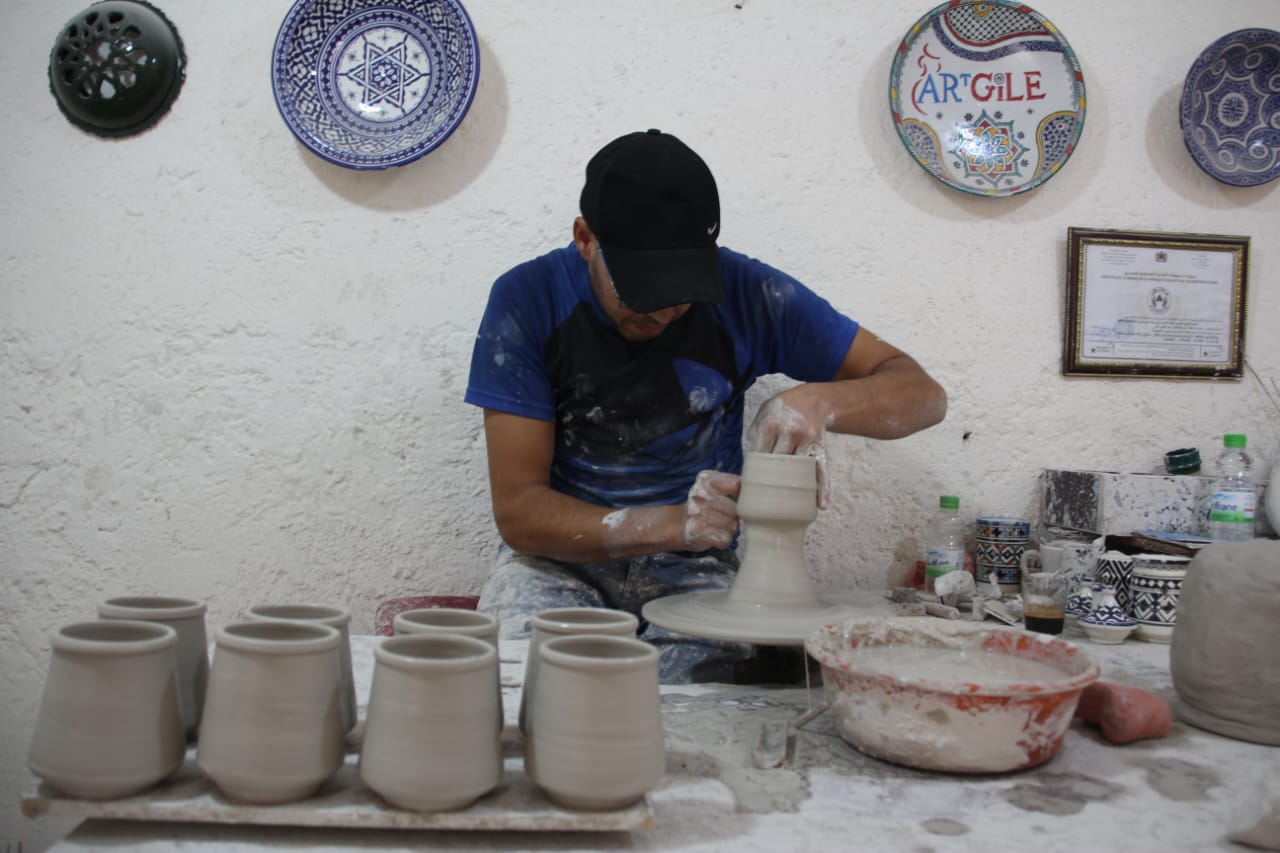
What Is a Pottery Workshop in Fes Like?
Pottery is an activity you understand through touch. Clay responds to the pressure of your fingers, the moisture on its surface, and the way you support it.
Watching a skilled artisan can make the process look effortless. Trying it yourself reveals how much attention sits behind even a simple bowl.
Working with clay
During a beginner pottery experience, you become familiar with the material: how it bends, how it holds a shape, and what happens when you press too firmly or unevenly.
Depending on the session, your introduction may involve working at the wheel, shaping by hand, or exploring finishing techniques. If using a pottery wheel is the main reason you want to join, mention this when booking so the workshop matches your expectations.
A modest first project gives you plenty to explore. You begin to notice the thickness of a wall, the curve of an edge, and the difference a small movement makes.
Learning to enjoy the process
Your first piece may lean slightly. Its rim might be uneven. That is part of learning how the material behaves.
Pottery suits travelers who enjoy experimenting without needing a perfect result immediately. The pleasure comes from making something develop under your hands and understanding how the artisan helps you adjust it.
Who should choose pottery?
A pottery workshop is a good choice if you:
- Enjoy tactile activities and working directly with your hands.
- Have always wanted to try shaping clay.
- Prefer exploring forms to following a geometric arrangement.
- Do not mind getting a little messy.
- Want to understand the skill behind handmade bowls, plates, and other ceramic objects.
Explore our pottery workshop in Fes to see the session details and arrange your visit.
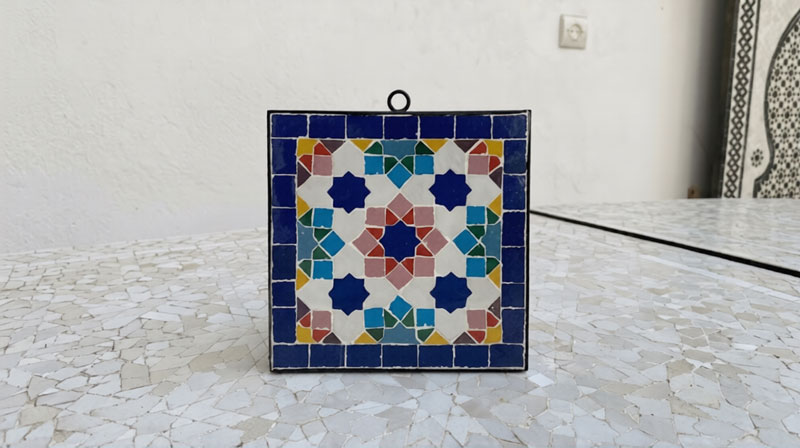
What Is a Zellige Workshop in Fes Like?
Zellige is Moroccan mosaic tilework made from small glazed ceramic pieces arranged into decorative patterns.
During a zellige workshop, you begin to understand a finished mosaic by looking at its individual parts. A design that seems complicated becomes easier to follow when you identify repeated shapes, color sequences, and the way its edges meet.
Creating with shapes and colors
The appeal of zellige is partly in the choices you make. A limited palette can create a quiet, balanced design, while contrasting colors can make the geometry stand out.
You do not need to draw a complex pattern from memory. Guided assembly helps you understand where pieces belong and how each one contributes to the whole.
If you enjoy puzzles, arranging objects, or noticing patterns in architecture, this process may feel especially satisfying.
Discovering the artisan’s technique
Our zellige experience introduces visitors to tile cutting and mosaic assembly under artisan guidance.
Traditional assembly can involve placing the colored faces downward before securing the back. Seeing the design revealed helps you appreciate the planning behind the surface.
Tool use should always follow the artisan’s instructions. For children or anyone who prefers to concentrate on arranging tiles, discuss the appropriate format before booking.
Who should choose zellige?
A zellige workshop is a good choice if you:
- Love Moroccan tile patterns and colorful interiors.
- Enjoy detailed work and puzzle-like activities.
- Prefer composing a design from existing shapes.
- Want to understand the craftsmanship behind mosaic decoration.
- Like the idea of creating a small decorative panel.
Discover our zellige workshop in Fes for the full experience.
Which Workshop Is Easier for Beginners?
Both are accessible to beginners, but they ask you to concentrate in different ways.
Pottery asks you to develop a feeling for pressure, balance, and movement. A small change in your hand position can affect the shape you are making. That unpredictability is part of its appeal.
Zellige asks you to pay attention to placement, spacing, and the relationship between shapes. A guided pattern can make the next step clearer, although careful fitting still takes patience.
If you like a defined sequence, you may prefer zellige. If you enjoy experimenting and discovering what happens as you work, pottery may suit you better.
Neither choice requires you to arrive with artistic talent. Curiosity and a willingness to try are more useful than previous experience.
Which Is Better for Families With Children?
The best choice depends on your child’s age, interests, and attention span.
A child who enjoys squeezing, shaping, and building may be drawn to pottery. Someone who likes puzzles, colors, and arranging small objects may prefer mosaic assembly.
Before booking a family workshop, tell us:
- The ages of the children.
- How many adults will participate.
- Whether your children prefer clay or patterns.
- Any assistance they may need.
For zellige, tile cutting and handling require appropriate supervision. Ask which steps children can participate in and whether an assembly-focused activity would suit them.
For pottery, keep expectations flexible. Enjoying the clay and trying a new skill can be more rewarding than aiming for a perfectly shaped object.
Which Should Couples or Friends Choose?
Think about what your group enjoys doing together.
Choose pottery for a playful shared experience. You can compare your attempts, notice how differently each person approaches the clay, and enjoy the unexpected results.
Choose zellige for a shared interest in design. You might work with similar colors or choose completely different patterns that reflect each person’s taste.
You do not all need the same level of confidence. If your group has mixed interests, ask about a session that introduces both crafts.
How Much Time Should You Allow?
Our published standalone options include a two-hour pottery workshop and a zellige workshop of approximately one hour. Confirm the timing for your chosen session when booking, particularly if you want a larger project or a customized experience.
Allow additional time for travel to the studio and any collection arrangements. It is easier to enjoy the activity when you are not watching the clock for a train or airport transfer.
For a short visit to Fes, a focused session can fit around sightseeing. If craft is a major reason for your trip, consider giving yourself longer to explore both techniques.
PRACTICAL TRAVEL GUIDE
Can You Take Your Creation Home?
This is an important question to ask before choosing your workshop, especially if you leave Fes that day.
Taking home pottery
Dry clay is not the same as fired ceramic.
A newly shaped piece needs drying time. Turning it into durable ceramic requires kiln firing, and glazing may involve further processing. These stages cannot simply be compressed into a short beginner session.
Ask what happens to the specific piece you make:
- Will it leave the studio unfired?
- Is firing available for your project?
- When would it be ready for collection?
- Can delivery or shipping be arranged, and at what cost?
If you hope to use your piece for food or drink, also ask about its finished suitability for that purpose. Do not assume a freshly made workshop object is ready for everyday use.
Taking home zellige
Our standard zellige workshop includes a small mosaic panel, typically 12 × 12 cm, with protective packaging.
Follow the artisan’s advice about setting time, handling, and transport. A panel may be compact, but it still needs protection from impacts and pressure inside your luggage.
Tell us your departure plans beforehand so we can explain the practical arrangements for your chosen activity.
What Should You Wear?
For either workshop, choose comfortable clothes that allow you to move your arms freely. Closed-toe shoes are a practical option in a working studio.
For pottery, sleeves that roll up easily are useful. Remove rings or bracelets that could get in the way, and wear something you do not mind getting clay on.
For zellige, choose clothes suitable for a practical activity and follow the instructions given for tools and materials.
You can also take photographs to remember the experience. Ask before photographing artisans or other participants, and put your phone aside when a task needs both hands.
Can You Try Pottery and Zellige Together?
Yes, if both activities appeal to you, a combined experience can be the most satisfying choice.
Trying both gives you two perspectives on ceramic craft. With pottery, you explore how a form develops from soft clay. With zellige, you discover how finished ceramic pieces become part of a larger design.
You can explore our half-day pottery and ceramic workshop or browse our workshop options and ask which program best matches your interests.
A combined session is particularly useful when different members of your group want to try different activities.
How to Choose Your Workshop
Your decision does not need to be complicated.
Choose pottery if your first thought is:
“I want to feel the clay and see what I can make.”
Choose zellige if your first thought is:
“I want to create one of those beautiful Moroccan patterns.”
Choose both if your first thought is:
“I want time to understand the crafts and try different techniques.”
Then check the practical details: session length, children’s participation, the project you will make, and how you will take it home.
The right workshop is the one that fits both your curiosity and your travel schedule.
Frequently Asked Questions
Do I need experience for a pottery or zellige workshop in Fes?
No previous experience is needed for a beginner session. Artisans introduce the materials and guide you through the activity. You can arrive without knowing how to use a pottery wheel or assemble a mosaic.
What is the main difference between pottery and zellige?
Pottery involves shaping clay into an object. Zellige involves arranging glazed ceramic pieces into a mosaic. Pottery focuses on form and touch, while zellige focuses on pattern, color, and placement.
Is a zellige workshop the same as pottery painting?
No. Pottery painting involves applying decoration to a ceramic surface. Zellige involves assembling separate tile pieces into a design. Choose painting if you particularly enjoy brushwork, or zellige if you prefer working with shapes.
Which workshop is less messy?
Zellige generally involves less contact with wet clay than pottery. However, it remains a practical craft activity involving materials and assembly, so comfortable clothes that can get dirty are sensible for both.
Which activity is better if I am leaving Fes the same day?
Discuss your departure time before booking. Zellige may be more convenient when your priority is a compact decorative takeaway, but handling and setting instructions still matter. Fresh pottery requires particular care, and kiln firing takes additional time.
Can we book as a couple, family, or group of friends?
Contact us with your preferred date, group size, and the ages of any children. We can help you choose a suitable workshop format and confirm availability.
Create Your Own Memory of Fes
A workshop gives you time to stop, look closely, and make something with your own hands.
Whether you choose the changing shape of clay or the careful arrangement of zellige, you will leave with a better understanding of the work behind Moroccan crafts, and a personal experience to remember.
Ready to choose your workshop?