
CULTURE & HERITAGE
Moroccan
Pottery
A Complete Guide to History,
Techniques, Styles and the Living
Tradition of Fes
Discover the beauty, history and craftsmanship of Moroccan pottery. From ancient traditions to modern creations, explore how clay, culture and creativity come together in one of Morocco’s most treasured art forms.
By Fes Pottery Art
Introduction
Moroccan pottery is more than just beautiful objects, it is a living heritage, a reflection of the country’s history, culture and people. For centuries, clay has been shaped by Moroccan hands into vessels, tiles, and decorative pieces that are both functional and deeply symbolic.
In this comprehensive guide, we invite you to explore the fascinating world of Moroccan pottery: its history, techniques, regional styles, symbolism and its place in modern Morocco. Whether you are a traveler, a pottery lover, or simply curious about this ancient craft, this article will take you on a journey through the art, tradition and people behind Moroccan ceramics.
“In Morocco, pottery is not just an object. It is a story, a tradition and a connection between generations.”
— Fes Pottery Art
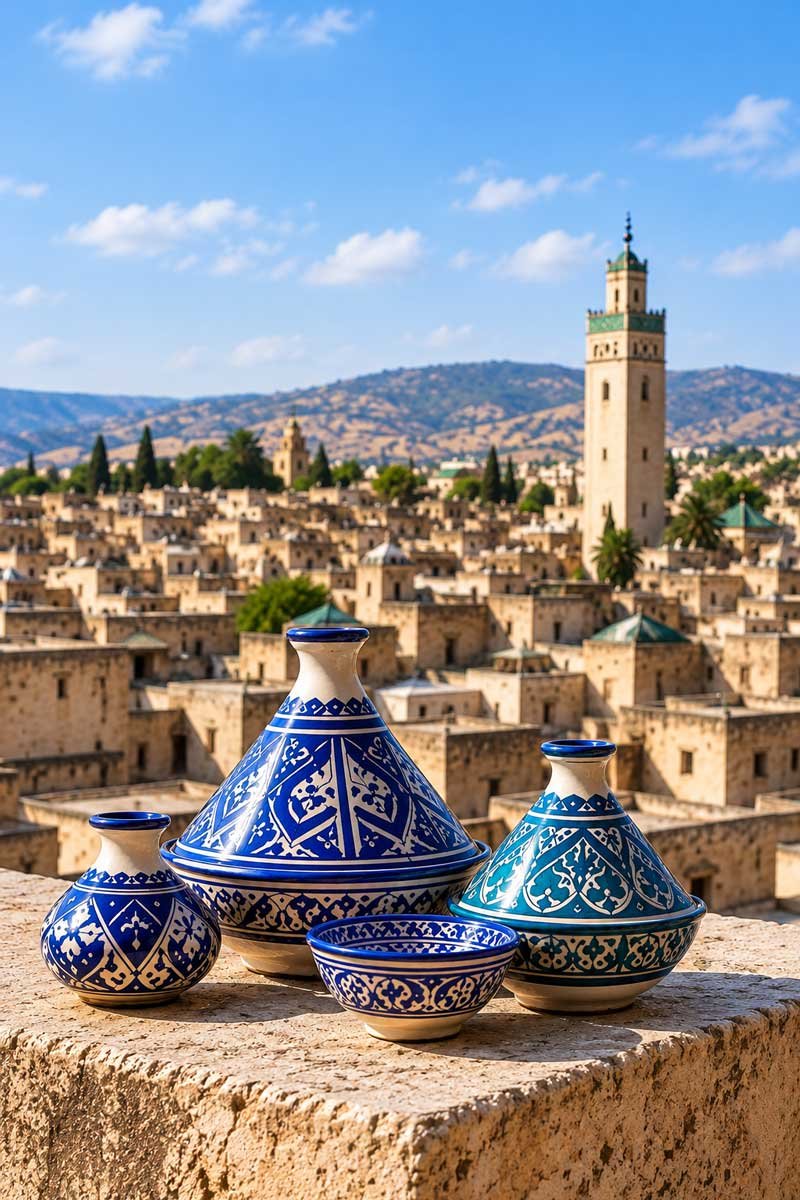
Table of Contents
- Introduction
- What Is Moroccan Pottery?
- A Brief History
- Cultural Significance
- Pottery by Region
- Materials and Tools
- How Moroccan Pottery Is Made
- Styles and Designs
- Colors and Their Meanings
- Moroccan Pottery in Daily Life
- Fes Pottery: A Closer Look
- Modern Moroccan Pottery
- How to Choose Authentic Pottery
- Caring for Your Pottery
- FAQ
- Conclusion
Join a Pottery Workshop in Fes
Get hands-on experience, learn traditional techniques and create your own Moroccan ceramic piece.
Related Articles
The Rich History of Pottery and Mosaic in Morocco
Read More →
7 Things You’ll Learn in a Pottery Workshop in Fes
Read More →
Pottery Painting Ideas Inspired by Morocco
Read More →
How Moroccan Zellige Is Made
Read More →
What Is Moroccan Pottery?
Moroccan pottery refers to ceramic objects handmade in Morocco using traditional techniques passed down through generations. It includes a wide range of items such as:
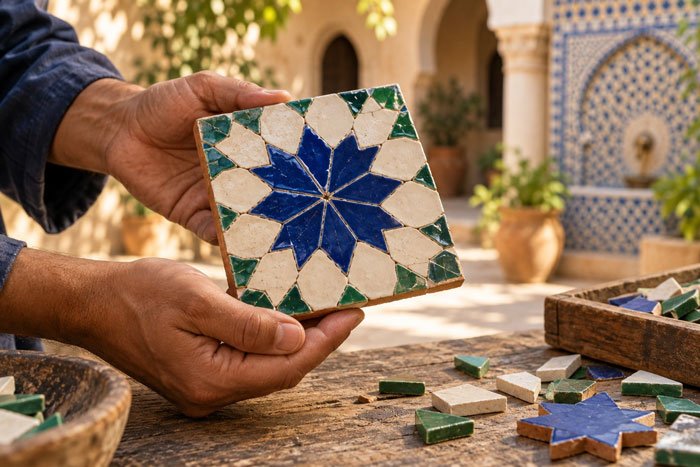
Tiles (zellige)
Geometric hand-cut ceramic pieces.

Bowls and plates
Everyday and decorative tableware.
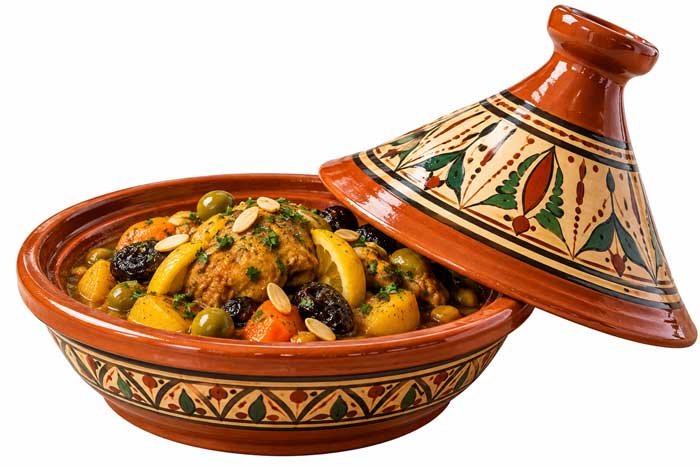
Tagines (cooking pots)
Iconic vessels for slow cooking.
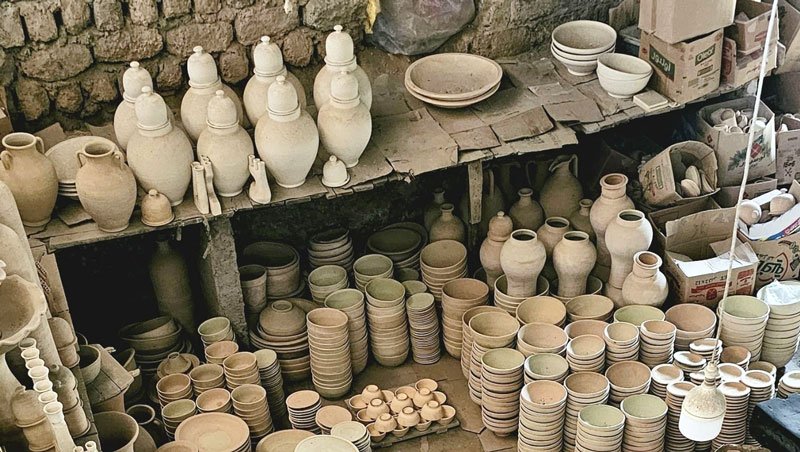
Vases and jars
Functional forms with regional motifs.

Decorative art pieces
Hand-painted objects for the home.
Every piece of Moroccan pottery carries the soul of a place, a people and a tradition.
A Brief History of Moroccan Pottery
The history of Moroccan pottery dates back thousands of years, with archaeological evidence showing that pottery production existed in Morocco since prehistoric times. Over the centuries, Moroccan ceramics absorbed Amazigh, Islamic, Andalusian and Mediterranean influences.
Prehistoric Era
Early pottery was simple and functional, used for storage and cooking.
Amazigh Influence
Amazigh communities developed distinctive geometric designs still visible in rural pottery.
Islamic Era
New artistic influences introduced arabesque patterns, calligraphy and refined decoration.
Andalusian Influence
Artisans brought advanced ceramic techniques, especially to cities such as Fes.
Modern Day
Moroccan pottery continues to evolve while preserving traditional roots and handmade identity.

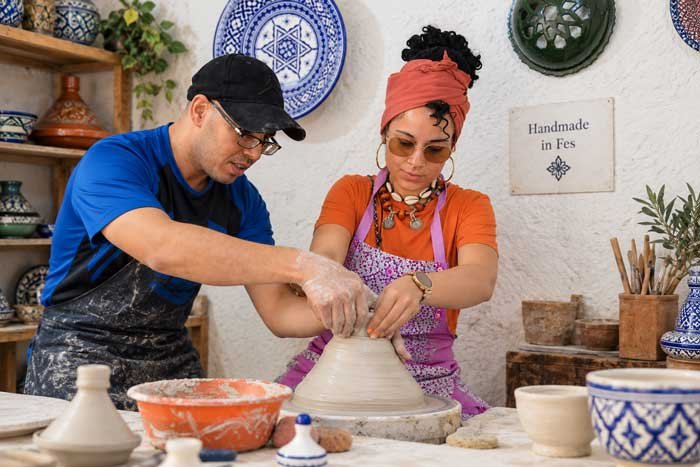
A Moroccan artisan shaping clay in Fes.
The Cultural Significance of Pottery in Morocco
In Morocco, pottery is not just a craft, it is a part of daily life, culture and spiritual expression. Ceramics are used in homes, mosques, palaces and public spaces. They represent hospitality, creativity and a deep connection to the land.
Traditional pottery is often given as a gift during special occasions such as weddings, births or religious celebrations. Patterns and colors can carry symbolic associations including protection, harmony, fertility and good fortune.
“Travel, learn, create and take home a piece of Morocco.”
— Fes Pottery Art
Moroccan Pottery by Region
Each region of Morocco has its own pottery traditions, materials and styles. Here are some of the most well-known:
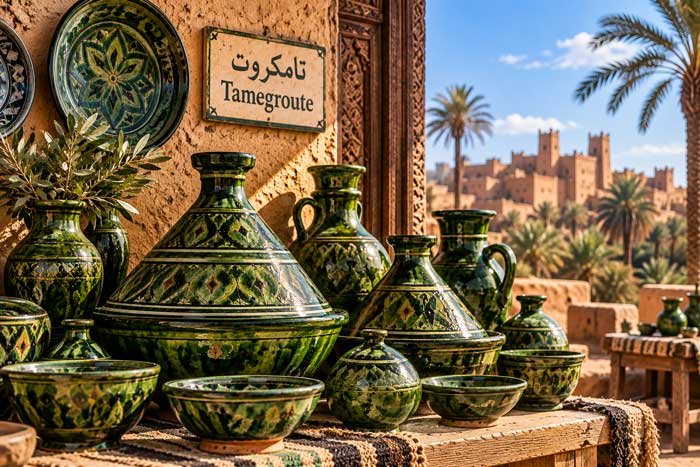
Tamegroute
Famous for its distinctive green pottery made from natural minerals.
Fes Pottery: Blue, White and a Living Workshop Tradition
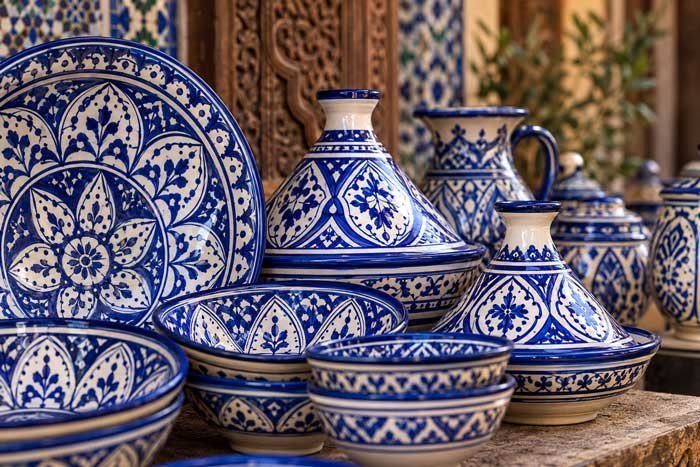
Fes occupies a special place in the imagination of Moroccan craftsmanship. The city’s medina is known for dense networks of specialized trades, and ceramics belong to that larger craft landscape. Blue-and-white pottery is one of the visual signatures most often associated with Fes: cobalt-colored decoration stands out against a pale ground, forming floral, geometric and calligraphic compositions that can be delicate or densely filled.
The attraction of Fes pottery is not only its palette. It is the connection between object making and a wider decorative culture. The same city that produces painted ceramics is also celebrated for zellige, carved plaster, woodwork and metalwork. Geometry and rhythm move between these media. A visitor who studies a ceramic plate and then looks carefully at a madrasa wall may recognize a shared preference for repetition, balance and structured ornament even though the materials and tools differ.
In a working pottery studio, the transformation from raw clay to finished object makes the craft easier to understand. A potter’s hands continually correct the form: centering, opening, lifting and compressing. The apparent ease of an experienced thrower can be misleading. Small changes in pressure can alter a wall; too much water can weaken the clay; uneven thickness can create problems during drying or firing.
Decoration adds another layer. Painting a curved surface is different from drawing on paper because the artist must anticipate how the pattern wraps around volume. Borders need to meet cleanly, central motifs need proportion, and brush pressure affects line character. The most convincing handmade pieces often reveal the human rhythm of the painter: repeated motifs are related but not mechanically identical.
Fes is therefore particularly valuable for travelers who want to move beyond shopping and see pottery as a process. Fes Pottery Art’s studio tour is designed around that curiosity, showing visitors stages of production and creating opportunities to speak with artisans. For a deeper experience, hands-on workshops let beginners feel how much coordination is hidden inside a seemingly simple bowl.
See the Craft Up Close in Fes
Visit a working studio, follow the pottery and mosaic process, and meet local artisans.
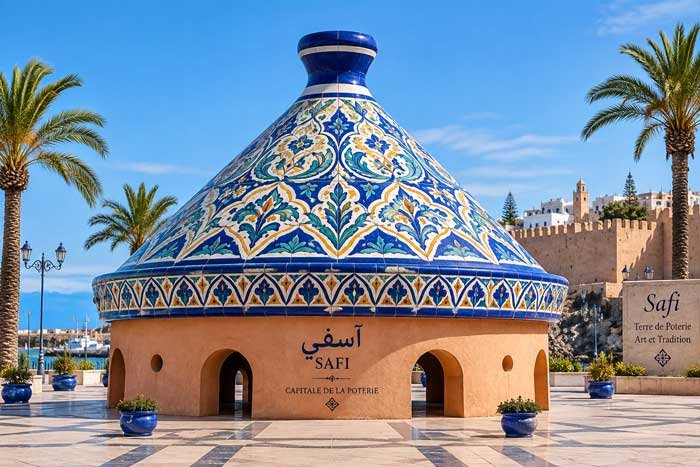
Safi Pottery
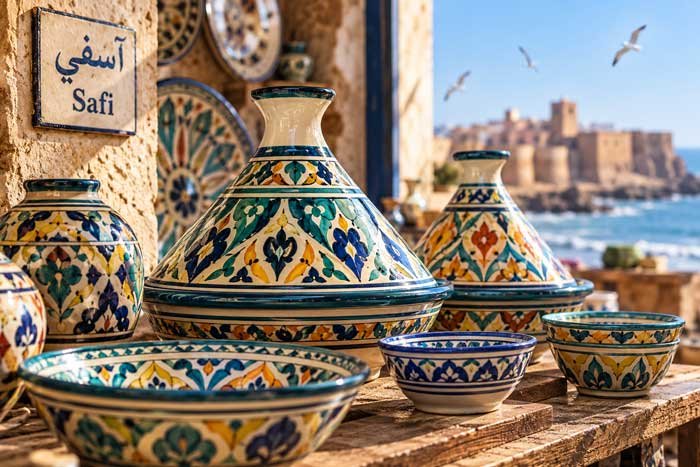
Safi is one of Morocco’s best-known ceramic centers and offers a useful contrast with Fes. Where Fes is often imagined through cobalt blue and refined urban patterns, Safi is associated with a broader, often more exuberant palette. Ceramics can feature strong blues, greens, yellows and earthy tones, with decorative approaches ranging from traditional motifs to contemporary studio work.
The city’s ceramic identity developed through local production, specialized workshops and an economy that served both Moroccan consumers and outside markets. Safi pottery is not one fixed visual formula. You may encounter practical household ware, decorative plates, sculptural forms and modern pieces that reinterpret older techniques.
When comparing Safi and Fes, avoid treating the difference as a contest. They represent distinct ceramic environments. Fes helps readers understand the relationship between pottery and the decorative arts of an imperial city; Safi demonstrates how a major production center can sustain experimentation, color and commercial range.
Tamegroute Pottery
Tamegroute pottery is one of the easiest Moroccan ceramic traditions to recognize at a glance. The village, located in the Drâa Valley of southern Morocco, is famous for pottery covered in a distinctive green glaze. The green can range from olive and moss to deeper emerald-like tones, often with irregularities, drips and tonal variation that make each surface feel alive.
The appeal of Tamegroute lies partly in that unpredictability. Traditional firing and glaze conditions can create surfaces that are not perfectly uniform. Collectors may value small variations because they record the interaction between mineral glaze, flame, heat and placement in the kiln. At the same time, buyers should be careful about romantic claims: not every green-glazed pot sold under the name Tamegroute necessarily comes from the village.
Tamegroute forms are often robust and sculptural, including bowls, candlesticks, jars and decorative vessels. Their visual power comes less from intricate painted pattern than from silhouette, glaze and texture.
Rural and Amazigh Pottery Traditions
Some of the most historically revealing Moroccan pottery is also the least glossy. Rural pottery traditions, many associated with Amazigh communities, often preserve hand-building methods and symbolic decoration that differ sharply from urban workshop ware. Makers may construct vessels without a fast wheel, using coils, paddling, scraping and smoothing to achieve the desired form.
Decoration can include painted or incised geometric signs, bands, triangles, zigzags and other repeated marks. Interpretations of individual symbols should be approached carefully because meanings can vary by region, family, period and object. Online descriptions sometimes assign a universal meaning to every diamond or line; real craft traditions are usually more complex.
Rural pottery reminds us that ceramic value is not measured by polish. A hand-built water vessel or cooking pot may carry generations of technical adaptation: wall thickness suited to use, a base designed for a particular hearth, a surface treatment that responds to local firing conditions.

How Moroccan Pottery Is Made
The exact sequence varies by workshop and object, but most pottery follows a recognizable transformation from raw clay to fired ceramic. Understanding these stages is one of the best ways to appreciate handmade Moroccan pottery because each stage introduces risks that skilled makers learn to manage.
1. Clay preparation. Clay may contain particles, air pockets or uneven moisture that interfere with forming. The maker works the material until it has a consistent texture. In a studio setting this can involve wedging or kneading, recycling trimmings and adjusting moisture.
2. Forming. Wheel-thrown pottery begins by centering a lump of clay on a rotating wheel. The potter opens the center, establishes the floor and pulls the walls upward. Hand-built pieces may be pinched, coiled, slab-built or shaped with molds and simple tools.
3. Drying and refining. Pieces dry gradually. If one part dries much faster than another, stress can cause cracks or warping. When the clay reaches the right firmness, the potter may trim the base, refine the profile or add carved details.
4. First firing and decoration. The first firing transforms fragile dry clay into ceramic material. Depending on the workshop, decoration may occur before or after an initial firing. Painted designs, slips and glazes introduce color and surface effects.
5. Glaze firing. A later firing matures the glaze and decoration. Temperature, kiln atmosphere, stacking and glaze chemistry all influence the result. This is why ceramics involve both art and material science.
Clay, Tools, Kilns and Glazes
Clay is the foundation of pottery, but “clay” is not one universal substance. Mineral composition affects color, plasticity, firing behavior and compatibility with glazes. Moroccan workshops may use locally sourced clay, commercially prepared bodies or blends chosen for specific products.
The potter’s wheel is the most visually iconic tool, yet many other tools shape the finished object: wooden ribs, metal scrapers, wires, sponges, brushes, trimming tools and simple handmade implements. Traditional workshops often demonstrate an important principle of craft: a tool does not need to be technologically complex to demand sophisticated skill.
Kilns provide the heat that makes ceramics permanent. Historically, fuel availability and kiln design influenced production. Contemporary workshops may use gas, electric or other firing systems alongside more traditional approaches.
Glazes create color, sheen, texture and a less porous surface. Moroccan ceramics are famous for blue, green, white and multicolored finishes, but glaze chemistry matters for more than appearance. If a vessel will contact food, buyers should ask whether it was produced and tested for food use.
Colors, Patterns and Decorative Language
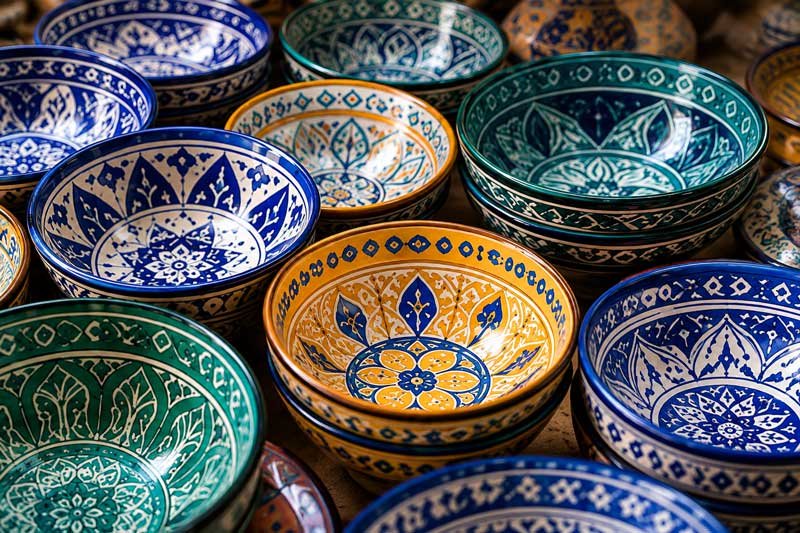
Color is one of the fastest ways people identify Moroccan pottery. Fes is strongly associated with cobalt blue on a light ground; Tamegroute with green glaze; Safi with a more varied palette. Yet color alone cannot prove origin. Contemporary workshops work across palettes, and export markets encourage imitation. Think of color as a clue, not a certificate.
Geometric pattern is equally important. Stars, polygons, interlaced bands and repeating borders create visual order through symmetry and rhythm. These patterns connect ceramics to the broader world of Moroccan decorative arts, especially zellige.
Vegetal motifs introduce leaves, flowers, vines and stylized organic forms. Calligraphic decoration may incorporate Arabic script or letter-inspired compositions. Some contemporary makers combine traditional borders with modern negative space, simplified linework or new color combinations.
When reading symbolism, caution is valuable. Moroccan design is rich with cultural and religious associations, but internet guides frequently overstate fixed meanings. A motif may have a local interpretation, a decorative function, or multiple meanings depending on context.
Create Your Own Moroccan Design
Learn Moroccan motifs, brush control and composition in a hands-on pottery designing and painting workshop in Fes.
Pottery, Zellige and Moroccan Architecture
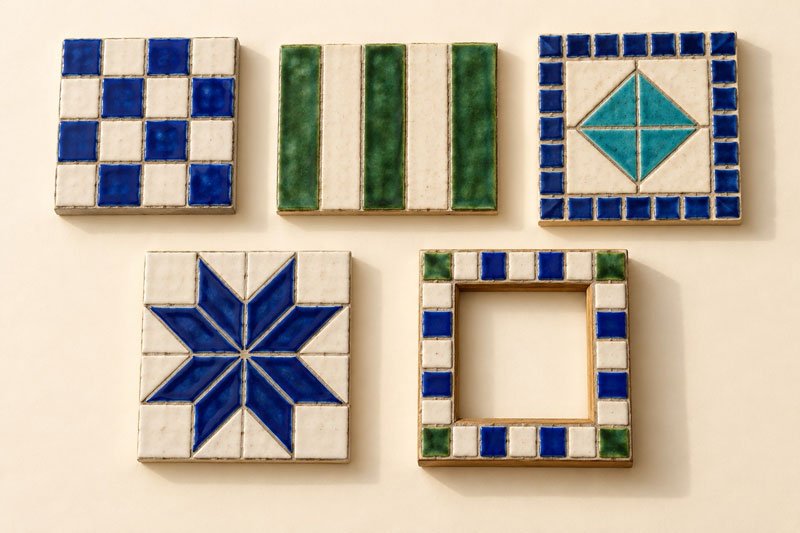
Pottery and zellige share clay and fire, but they become different things. Pottery is usually a three-dimensional object: bowl, jar, cup, plate or vessel. Zellige is architectural mosaic made from glazed tiles cut into shapes and assembled into geometric compositions. The crafts intersect in material knowledge and decorative language, especially in cities such as Fes.
This relationship is visible throughout Moroccan architecture. A courtyard fountain may combine a ceramic basin, zellige surface, carved plaster and wood. The eye moves from one craft to another, yet the composition feels coherent because proportions, color and geometry are coordinated.
For visitors, a combined pottery and zellige workshop is particularly revealing. Throwing clay emphasizes volume, balance and touch; cutting and arranging zellige emphasizes geometry, repetition and precision. Experiencing both makes it clear that Moroccan craft is a network of specialized disciplines that have developed alongside one another.
Discover Moroccan Zellige
Learn traditional Moroccan tile mosaic and understand how geometry connects pottery with architecture.
Common Types of Moroccan Pottery
Moroccan pottery appears in many forms, and understanding function helps you choose pieces more intelligently. Tagines are perhaps the most famous. Some are designed for cooking, while others are decorative or intended mainly for serving. Never assume a brightly decorated tagine can go directly over heat; confirm its intended use with the seller.
Bowls and plates range from small condiment dishes to large communal platters. Their broad surfaces make them ideal for painted decoration. Cups, vases, jars and candleholders offer different silhouettes and may be easier to pack depending on size.
Ceramic tiles and zellige pieces belong to the architectural side of the tradition. They can be purchased as individual decorative objects or incorporated into larger installations.
Decorative objects increasingly include contemporary shapes made for international interiors. These pieces can still be authentic expressions of Moroccan craftsmanship even when the form is new. Authenticity is better understood as truthful origin, materials and making process than as compulsory imitation of an antique design.
How to Recognize Handmade Moroccan Pottery
No single visual test can guarantee that a piece is handmade, but several observations can help. Start with repetition. On a hand-painted plate, repeated motifs often show subtle differences in line thickness, spacing or curvature. These variations should feel coherent rather than careless.
Look at the foot and underside. Handmade pieces may show trimming marks, slight asymmetry or evidence of how the object was supported during firing. Glaze may stop before the foot ring. Irregularity is not automatically proof of quality: cracks, unstable bases and poorly attached handles are defects.
Ask questions. Where was the piece made? Is the workshop known? Was it thrown, molded or hand-built? Is it intended for food, decoration or cooking? A trustworthy seller should be comfortable distinguishing these categories.
Price is another clue but not a guarantee. Genuine handwork requires time, and extremely low prices can be difficult to reconcile with skilled labor. The best approach is to combine observation, provenance, conversation and realistic expectations.
Buying and Caring for Moroccan Ceramics
When buying pottery in Morocco, begin with intended use. If you want a decorative plate, focus on design, condition and provenance. If you want dinnerware, ask specifically about food safety and care instructions. If you want cookware, confirm that the object was made for heat and ask how it should be seasoned, heated and cleaned.
Inspect the piece in good light. Look for cracks, major chips and unstable repairs. Small pinholes or glaze variations may be normal for handmade ceramics, but structural damage is different.
For transport, wrap ceramics individually and protect rims, handles and lids. Place smaller wrapped pieces inside larger ones only if there is enough cushioning to prevent contact. If flying, particularly valuable or delicate pieces are often safer in hand luggage when airline rules and size allow.
At home, follow the maker’s instructions. Avoid assuming that handmade ceramics are dishwasher, microwave, oven or stovetop safe. Sudden temperature changes can stress some ceramic bodies. Proper care protects both the object and the story you brought home.
Experience Moroccan Pottery in Fes
Reading about pottery changes what you notice; touching clay changes your understanding. In Fes, a workshop can turn abstract terms such as centering, wall thickness, trimming and glazing into physical experience. Beginners quickly discover that clay responds to every movement.
Fes Pottery Art offers several ways to engage with the craft. Travelers who mainly want to observe can choose the pottery and mosaic studio tour, which focuses on the production environment and conversation with artisans. Visitors who want to create can join a two-hour pottery and ceramic workshop. A half-day format gives more time for technique, while the three-day pottery and zellige workshop is better suited to people who want a deeper immersion.
Painting is another accessible entry point. Working on a prepared ceramic form lets participants focus on Moroccan motifs, brush control, composition and color rather than mastering the wheel in a short session.
The value of a workshop is not that a beginner will become a master potter in two hours. It is that the finished ceramics you see afterward will look different to you. You will understand why centering matters, why drying cannot be rushed, why a painted border takes concentration and why firing is part of the creative process rather than a simple final step.
Experience Moroccan Pottery in Person
Choose a studio visit, a short hands-on workshop or a deeper pottery and zellige experience in Fes.
Frequently Asked Questions About Moroccan Pottery
What is Moroccan pottery?
Moroccan pottery is ceramic ware made in Morocco using fired clay and regional craft traditions. It includes cooking vessels, plates, bowls, jars, decorative ceramics and architectural tile. Styles vary significantly between regions such as Fes, Safi and Tamegroute.
What is Fes pottery known for?
Fes pottery is especially associated with refined blue-and-white decoration, urban workshop craftsmanship and a close relationship with the city’s zellige and decorative arts traditions.
Why is some Moroccan pottery green?
The most famous green Moroccan pottery is associated with Tamegroute in southern Morocco. Its distinctive glaze can produce olive, moss and deeper green tones with natural variation created during firing.
Is Moroccan pottery handmade?
Some Moroccan pottery is fully handmade or hand-finished, while other products use molds, transfers or larger-scale production. Ask the seller about origin and process rather than assuming every item sold in a souk was made by hand.
Is Moroccan pottery food safe?
It depends on the clay, glaze, firing and production standards of the specific piece. If you intend to use pottery for food or cooking, buy from a reputable maker and ask directly whether the item is produced and tested for that use.
What is the difference between pottery and zellige?
Pottery usually refers to three-dimensional ceramic objects such as bowls, plates and vessels. Zellige is Moroccan mosaic tilework made from glazed ceramic tiles cut into geometric shapes and assembled into architectural patterns.
Where can I see pottery being made in Fes?
A working pottery studio is the best place to understand the process. Fes Pottery Art offers a pottery and mosaic studio tour as well as hands-on workshops where visitors can observe or try traditional techniques.
Can beginners join a pottery workshop in Fes?
Yes. Beginner workshops are designed to introduce the material and basic techniques with guidance from artisans. Short sessions focus on an achievable first experience rather than expecting mastery.
What should I buy as a Moroccan pottery souvenir?
Choose based on how you will use it. Small bowls, plates and cups are easier to transport; larger tagines and vases make stronger display pieces. For food use or cooking, confirm safety and care requirements before buying.
How should I pack Moroccan pottery for a flight?
Wrap each piece separately, protect rims and handles, prevent ceramics from touching one another and place cushioning around the entire object. Valuable small pieces are often safer in hand luggage when airline rules allow.
Moroccan Pottery Is a Living Tradition
The most memorable Moroccan pottery is not memorable because it matches a checklist of colors or motifs. It is memorable because it connects material, place and people. A Fes bowl carries the discipline of the wheel and brush; a Tamegroute vessel records glaze and fire; a rural hand-built pot preserves knowledge shaped around daily use. Together, these objects show that Moroccan ceramics are not one style but a living family of traditions.
If you are visiting Fes, seeing the process in person is the natural next step. Watch clay become form, compare pottery with zellige, ask artisans about their tools and try the material with your own hands. Even a short workshop can change the way you look at every ceramic object afterward.
Want to experience Moroccan pottery in person?
Join one of our hands-on workshops in Fes and create your own piece with local artisans.